Tân Châu Silk. Lãnh Mỹ A Silk
Tân Châu may be distant on the map, yet it remains intimately close to the hearts of those who love silk. This small town, set upstream along the Tiền River more than 70 kilometres from the centre of An Giang Province, has for over a century been cherished by connoisseurs as the “first land of silk” in the Mekong Delta.
The traditional silk-weaving village of Tân Châu took shape more than a century ago. For generations, it has been renowned for Lãnh Mỹ A, an aristocratic silk of incomparable distinction, helping earn Tân Châu its reputation as a land of mulberry and silkworms.
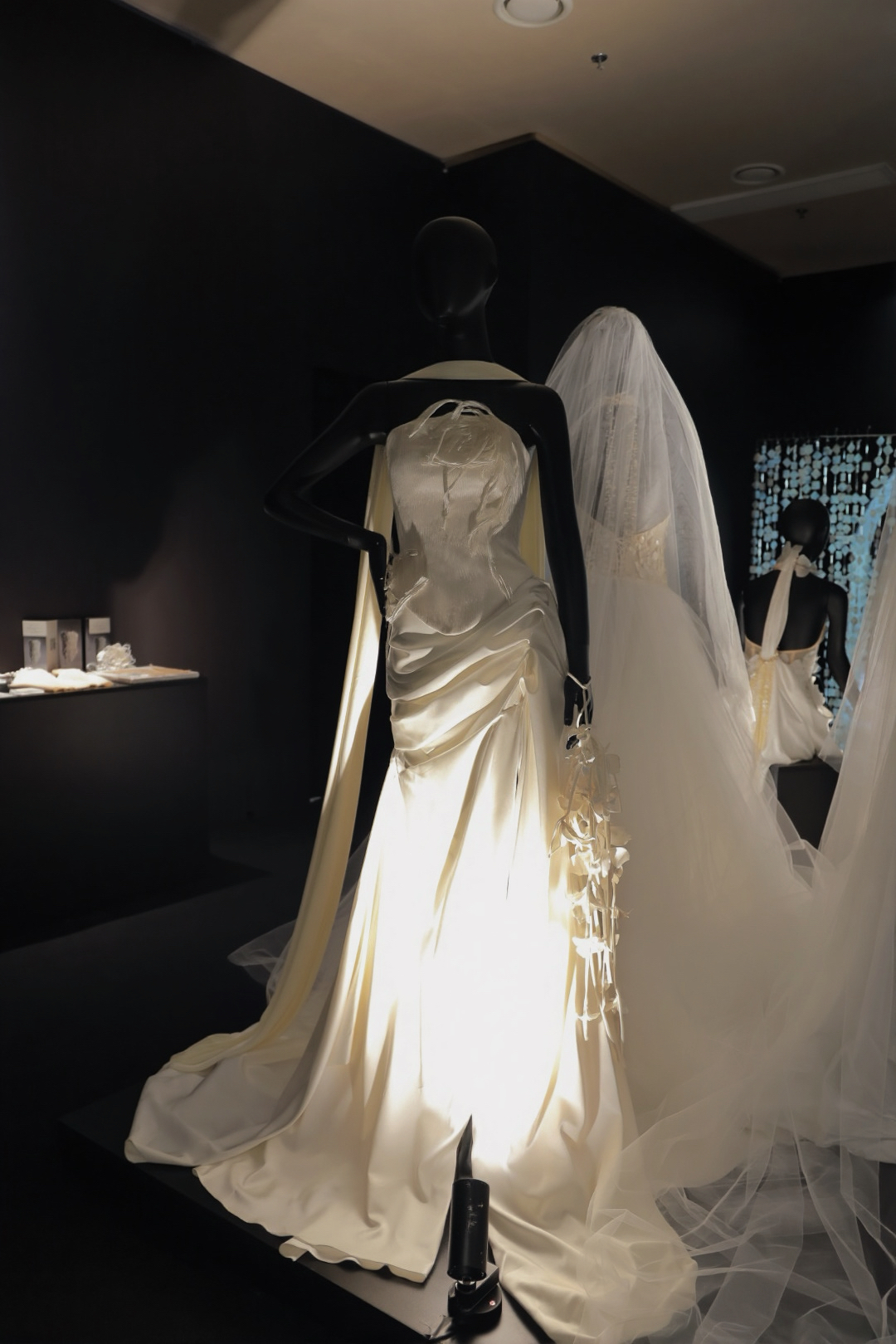
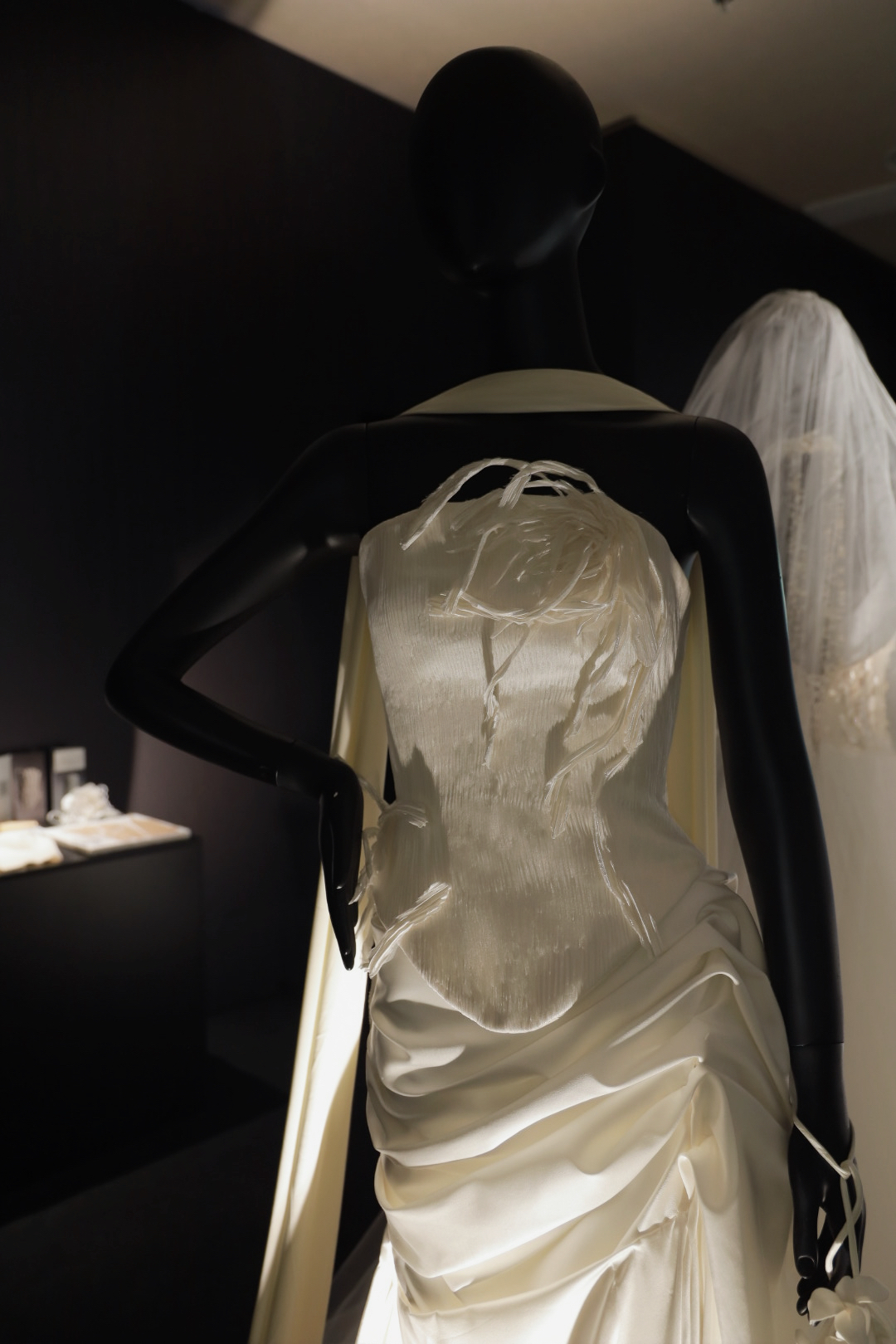
Lecia crafting bridal gowns from Tân Châu silk
“What young man is as graceful as one from Sông Của
What young woman as devoted as one from Tân Châu
Days and months spent weaving silk and tending mulberry
Honouring father, caring for mother, never minding hardship”
In Long Châu, the heart of Tân Châu’s traditional silk village, the name Lãnh Mỹ A—the exceptional jet-black silk produced only in Tân Châu—is spoken with unmistakable pride.
When the French first established colonial rule in Cochinchina, a Frenchman named De Colbert came to Tân Châu and, recognising that its soil and climate were ideal, founded a silkworm station devoted to mulberry cultivation, sericulture, and silk weaving. It was here that the celebrated Lãnh Mỹ A was created. Woven from the finest filament of the healthiest silkworms, then dyed again and again for months with the resin of the mặc nưa fruit, this smooth, deep-black silk feels like a caress against the skin: cool in summer, warm in winter, despite its feather-light fineness. The more it is worn and washed, the more luminous its black becomes—a black said to remain true until the fabric itself finally gives way. Because of its noble raw materials and the immense labour required to create each length, Lãnh Mỹ A was once reserved for the wealthy elite, worn on refined occasions such as theatre outings, festivals, and celebrations. A length of the silk was treasured like a family heirloom; even the famed “xá xị Xiêm”, a celebrated Thai silk, could not rival it. At certain periods, Tân Châu silk also reached India, Singapore, the Philippines, and beyond, where it was favoured by aristocratic and royal circles.
Around 1920, present-day Long Châu and many areas of Tân Châu were sparsely populated, with most families living by mulberry cultivation, silkworm rearing, and silk weaving. Between 1936 and 1940, Tân Châu became the largest silk centre in southern Vietnam, with large-scale reeling and weaving workshops; vast mulberry gardens stretching along the Tiền and Hậu rivers; dense rows of mặc nưa trees lining Provincial Road 952; and boats crowding the waterways like a floating hamlet. From dawn until deep into the night, the clicking of shuttles and the heavy rhythm of looms filled the air. Everywhere, lengths of Lãnh Mỹ A were laid out to dry as far as the eye could see. By the 1960s, Tân Châu silk was not only supplied domestically but exported to Thailand, Laos, Cambodia, the Philippines, France, and other markets. Its clientele was largely affluent and noble; garments made from Lãnh Mỹ A were reserved for festivals, weddings, and important occasions. Mr Trần Văn Hồng, 79, of Long Châu Ward, recalls that in earlier times, owning a set of Lãnh Mỹ A clothing was a precious thing, for it was costly and conveyed elegance and refinement. Even families of modest means would try to acquire a few sets for momentous occasions such as a child’s wedding or the Lunar New Year. Lãnh Mỹ A is distinctive: cool in hot weather, warm in winter, durable, water-resistant, and increasingly lustrous with time. In the past, owning clothing made from Lãnh Mỹ A was a dream for many, especially women from other provinces and cities.
In An Giang, mulberry was planted from the sandy riverbanks deep into the fields. Entire stretches of land unfolded in endless green, continuing from one village to the next. In some years, more than 10,000 hectares of mulberry were cultivated from Tân Châu and Chợ Mới all the way to the Cambodian border to feed the silkworms. A distinctive practice was that farmers did not pluck individual leaves; they cut the plants close to the base, gathered them into great bundles, and carried them home. In the dry season, families entered the busy production cycle. From early morning until nightfall, every house echoed with the click of shuttles, the tread of looms, and the pounding of cloth. In front yards, along village roads, and out toward the fields, Lãnh Mỹ A silk was spread everywhere to dry.
Yet under the fierce competition of inexpensive imported synthetic fibres, the market for Tân Châu silk gradually narrowed after 1945. Many households shifted from silk weaving to nylon weaving. In 1987, the Tân Châu Silk Company was founded, but after two years it dissolved, unable to compete with imported goods. With the domestic market paralysed and international channels not yet established, Tân Châu’s silk craft stagnated for decades. Hundreds of families uprooted their mulberry gardens, felled their mặc nưa trees, and turned to rice cultivation. From 1996 to 2012, only one household continued the traditional craft: that of Mr Nguyễn Văn Long, also known as Tám Lăng.
“The Queen of Silk”
From the first days of rearing silkworms until the moment they are ready to feed voraciously, the work demands meticulous, constant care. The farmers remain almost continuously beside the trays and cutting boards for mulberry leaves. Only when the silkworms are ripe and have spun golden cocoons are they placed onto frames to release their silk. At this moment, the weaving village becomes luminous. Beneath the sun, each household glows with golden silk frames. After reeling, the raw silk is unwound, twisted into stronger threads, and woven into lengths of fabric. In the early days of silk reeling and weaving in Tân Châu, artisans used old-style looms. The cloth width was only around forty centimetres, so garments had to be pieced together and lacked elegance. Gradually, the village developed looms of eighty and then ninety centimetres, while also refining the silk to be more beautiful and durable, with exquisite motifs such as cẩm tự, mulberry blossoms, chrysanthemums, hammock patterns, and mat patterns. Typically, a 90-metre length contains 12,550 warp threads. Lãnh Mỹ A is woven using an eight-harness satin method, the most difficult technique in silk weaving. The artisan must have sharp eyes and supremely skilful hands to create a bolt of silk so even and beautiful that it seems to have been made from a single thread. The silk is then boiled to remove the sericin before dyeing. Fine Lãnh Mỹ A has a smooth surface and a glossy black that brightens with time. When worn, one can sense the delicacy of the silk and the distinctive fragrance of the mặc nưa fruit.
“The process of cultivating mulberry and rearing silkworms is extremely demanding. We raise the silkworms for their cocoons, then weave the silk thread. In the past, it was woven on silk looms, and some traditional households still preserve that image today. The maker must put heart and mind into the product. From a silk thread to a length of cloth is an exceptionally elaborate process. There is a fruit called mặc nưa used for dyeing. The cloth must be dyed and sun-dried many times; only with good sunlight does it become firm and durable,” shared Mr Lê Trung Hiếu, Director of the An Giang Investment and Trade Promotion Centre and a son of Tân Châu.
Lãnh Mỹ A has the ability to regulate body temperature: cool in summer and warm in winter. Its silk is resilient, durable, and water-resistant. Because it carries, in each metre, the sensuous effects of skin, paper, and silk, it is affectionately known as lacquer silk. Lãnh fabric always has one glossy side and one matte side. Its surface is smooth, supple, deep black, and increasingly lustrous with use. Draped in mysterious Lãnh Mỹ A, one feels the softness and slip of the silk grain, while being gently enveloped by the delicate scent of mặc nưa. Every precise, labour-intensive stage contributes to the value of Lãnh Mỹ A. It is unfortunate that so many misunderstand luxury as something purely material, when true luxury resides in spirit. Rarity, refinement, exceptional aesthetics, almost unimaginable investments of time and space, and the attitude and skill of the maker—these are what create luxury. The finest things are therefore rare and arduous; behind every true luxury object lies a precise and moving philosophy of Beauty. For many years, Mr Tám Lăng and his family have treated the craft with composure, rigour, and steadfast fidelity, as if there were no other way.
The Dyeing Art of Tám Lăng
Once woven, the silk is dyed with mặc nưa fruit. In the past, people in Tân Châu dyed Lãnh with aged tree bark, then trod the cloth in mud. The fabric darkened, but the colour was unstable, fading quickly and turning reddish. Tám Lăng, then a strong and capable young man, heard that across the border in Cambodia there was a fruit called mặc nưa used especially for dyeing. He decided to cross the border and bring it back for the weavers in his region. The Khmer would crush the fruit for its resin, dye the fabric, rinse it, and dye it again, repeating the process until the silk had fully absorbed the black. “Khmer cloth took a long time to acquire its lustre, only after enduring much washing and handling. So when I returned to Tân Châu, I suggested that the weavers both dye and pound the cloth to open the silk fibres. Who would have thought that such hardship would immediately give Lãnh Mỹ A its soft, glossy, mysterious beauty…” In those days, the village had to go to Cambodia each year to buy hundreds of tonnes of mặc nưa fruit. In 1975, Tám Lăng stopped trading in the fruit, having succeeded in propagating the tree in his own homeland. “Mặc nưa determines the beauty of the colour. Lãnh Mỹ A is special because silk and mặc nưa suit each other. If you dye another fabric with mặc nưa, it will not be beautiful. But with silk, it is exquisite. Once it has absorbed enough mặc nưa, the more it is worn, the more beautiful it becomes. Wash it often, wear it for years, and it only grows more beautiful. It stays glossy, without fading or wrinkling.”
With some savings, Tám Lăng opened a large weaving workshop. He was captivated by Lãnh Mỹ A and wanted to use the knowledge gained from decades of working with mặc nưa to create a silk of exceptional beauty and polish. But war and hardship made luxury in clothing an impossible dream for most. Across Tân Châu, silk weaving ceased; mulberry fields were cut down; reeling workshops stopped turning; sericulture withered away. Most handlooms shifted to weaving common, inexpensive nylon thread. The great weaving households, grieving for the silk that had been the pride of their land, tried to hold on. Like a captain who leaves a sinking ship only after every passenger and crew member is safe, Tám Lăng resisted the death of Lãnh Mỹ A until the very end. By 1984, he finally had to close the last loom weaving Lãnh. More than half a century later, at the age of 88, the elderly Tám Lăng sat in his garden and calmly recounted the days of his youth, crossing forests in search of colour for Tân Châu’s most noble silk.
Today, Lãnh Mỹ A is woven from the finest silk of Bảo Lộc in Lâm Đồng and dyed with the resin of the mặc nưa fruit, a distillation of nature’s most refined elements. On contact with air and heat, the silk turns a deep black. It must then be rinsed, dried, rolled, and pounded so that the mặc nưa resin penetrates the silk fibres and gives the finished fabric its finest quality. On average, from weaving to completion, a piece of silk takes 45 days; during the rainy season, it can take as long as 60 days. Thanks to meticulous weaving and an extraordinarily complex dyeing process passed down through generations, Lãnh Mỹ A remains a remarkable silk, sought after by many.
Lengths of Lãnh must be dyed before the sun rises so they can be laid out in the first morning light. The silk is washed and rinsed in the river, then dried, dyed again, and repeated more than 100 times. Once dried, the cloth is rolled and pounded to create a lasting, lustrous sheen; this pounding process typically takes another five to seven days. In this way, the silk must be dyed through at least six “skins”. Each “beating” of the cloth, which opens the fibres so they can absorb the dye, is counted as one “skin”. Even then, the silk must pass through further stages such as sizing and rinsing before becoming a magnificent, precious length of Mỹ A silk with its glossy, mysterious black. This is precisely the distinctive beauty of Tân Châu silk. Mr Nguyễn Hữu Trí, an artisan at a Lãnh Mỹ A workshop in Tân Châu, explained: “After dyeing for 10 to 12 days, we pound and rinse to complete the first skin. After the first skin, we continue rinsing, then repeat the original process for about nine or ten days to dye the second skin. After the second comes the third. The process is the same, but the time becomes shorter. By the sixth skin, we call it the colour-beating stage. Once that beating is completed, the silk is finished.” The dyeing stage is considered crucial and painstaking, demanding both technical mastery and meticulous care. The silk must be immersed many times so that every filament absorbs the dye deeply and evenly before being dried. Drying must take place in strong sunlight, ideally over four clear days; on average, the immersion and drying process takes around 40 to 45 days.
On average, 500 metres of Lãnh Mỹ A take up to four months to complete. During long rainy periods, when dyeing cannot be finished, it may take even longer. It is often said that the value of an object lies not only in its material but in the devotion of its maker; here, that is undeniably true. Because the process is so elaborate and exacting, the finished silk is a masterpiece: glossy, jet-black, soft and smooth, cool to the touch, and moving in its delicacy.
From the Silkworms of Tân Châu to Bảo Lộc
Mr Tám Lăng calls the day that “fateful woman” came to him a blessed day. “In 1990, Miss ‘Râu’ came to the Tám Lăng workshop to ask about Lãnh. At that time, nearly 1,000 looms in the region were weaving only nylon. Miss ‘Râu’ urged me: ‘Return to weaving Lãnh Mỹ A! It must be woven from silk thread, dyed with natural colour, and made entirely by hand. If you can create a fabric even better than the old Lãnh Mỹ A, I will try to sell it!’ Miss ‘Râu’ was Rose Morant, a contemporary artist and designer for a French luxury fashion house, who had come to Vietnam in search of handmade, singular materials. From Rose’s clear and simple words, Mr Tám Lăng understood exactly what he had to do: create silk of unsurpassable beauty, regardless of the time and hardship it required.
Counting flaws in a length of silk was almost foreign to rural artisans, who had long worked by habit and inherited skill. Rose Morant, however, demanded rigorous quality control. “In the first year, I was allowed ten flaws in a 20-metre length of silk; after that, at most five,” Mr Tám Lăng recalled. If you understood what they considered a “flaw”, you might never again dream of becoming a silk weaver. If the shuttle paused for more than a few seconds, the silk thread would cool, and when weaving resumed, a mark as fine as a split hair could appear—one such mark was already considered a flaw, permitted only once in 20 metres of fabric. Across the countless stages of separating and twisting silk, dyeing, washing, pounding, drying, and ironing over many months, no more than five flaws—visible only under magnification—were allowed.
Because of Rose’s almost impossibly exacting requirements, Lãnh Mỹ A had to shift its source of raw silk. The cool, humid climate of Bảo Lộc in Lâm Đồng is the only place in Vietnam able to rear a silkworm variety originating from the foothills of Mount Fuji in Japan. A strong silkworm can produce around 700 metres of filament; beautiful Lãnh depends on beautiful silk, so only first-grade thread from healthy silkworms with spring-ripened cocoons is chosen. The filament must be long, smooth, seamless, and ivory-white, clear to the eye like fine fishing line. When Bảo Lộc silk arrives at the Tám Lăng workshop, specialist workers reel and twist it: each weft thread is made from eight cocoons, each warp thread from ten. The weaver dresses the loom and watches the surface without taking their eyes away for a second. If the silk rises even slightly, it must be adjusted; joins between segments must be hidden so that the whole length appears woven from a single thread. Even after weaving, another meticulous worker examines every millimetre with glasses and tweezers to rescue the faintest irregularities on the silk surface. The silk is then boiled to remove the silkworm’s sericin before being dyed. One hundred kilograms of crushed mặc nưa fruit provide enough resin to dye 20 metres of silk.
The first skin takes nine days, with 27 cycles of dyeing, washing, drying, and dyeing again. The second skin follows the same process for nine days. The third repeats it over six days. These first three skins allow the silk fibres to absorb the mặc nưa resin, giving the cloth depth and durability. The resin must be carefully controlled: too much and the fabric becomes heavy; too little and the black will lack depth and fade easily. By the fourth skin, the dyer begins to refine the colour for full, even saturation. The silk is pounded to open the fibres so the dye reaches the core, and the black emerges with extraordinary intensity. The fifth skin continues the dyeing to create surface gloss, followed by washing and pounding. At this point, the fabric’s beauty is almost fixed, but it still needs that tender, sensuous softness. In the sixth skin, the cloth is thoroughly pounded, washed in the Lãnh River, dried, and then ironed perfectly flat. “There is no exact number of mặc nưa dyeings, because if the weather is poor and the cloth does not absorb the resin, the first skin alone may require more than 50 dyeings. To achieve a length of Lãnh Mỹ A with shimmering black depth, cool and smooth against the skin, it must pass through around 100 dyeings, 20 washings, and about 10 poundings…” Nguyễn Hữu Trí counted on his fingers and toes, then shook his head, as if defeated by the complexity of the numbers. Trí also counted 13,000 crosswise threads in one metre of Lãnh, meaning 104,000 cocoons are combined into silk. How could the wearer ever imagine that they are carrying on their body the essence of so many silkworm lives?
From weaving to the completion of dyeing, a piece of Lãnh Mỹ A takes four months. “With Miss Rose’s exacting standards, we had to make Lãnh ten times more beautiful than before,” Mr Tám Lăng said, as simply as if recounting where he had sat that morning. In 1991, the first 500 metres made to “Rose’s standard” were produced. They did not meet the requirement, but Rose still purchased them, encouraging and guiding the Tám Lăng family as they refined their weaving and dyeing techniques. In 1992, they wove 1,000 metres, reaching 70 percent of the standard. They moved together slowly and surely, without impatience, discouragement, or doubt. From 1995 onward, Lãnh Mỹ A reached the quality required as a material for many of the world’s luxury fashion houses. Later, Rose Morant left Vietnam, and her company was transferred to Hanoia, Vietnam’s first high-end lacquerware atelier. Honouring and preserving handmade excellence became the path Hanoia chose, and with affection and commitment, it continued Rose Morant’s wish to protect Lãnh. Faithful Tám Lăng, for his part, remained true to his promise: to weave only the finest cloth.
Mr Tám Lăng has now retired, entrusting the workshop to his son. Under the bright noon sun, Trí led us to the mặc nưa fields and gestured across them: “This entire area grows mặc nưa only to sell to my family. In a good season, the harvest is enough to dye 10,000 metres of fabric, but today we make only 3,000 metres. We could weave up to 6,000 metres, but even with Hanoia’s great efforts, that is all the market can absorb. I worry deeply about the mặc nưa. If people cannot sell the fruit, they will cut down the trees and plant something more profitable. In Cambodia, mặc nưa has already disappeared. Only a few gardens remain here in Tân Châu…”
And the domestic retail market? Trí shook his head sadly. A preference for bright colours and fast, convenient consumption leaves almost no opening for Lãnh Mỹ A. Making the silk is arduous, and using it is demanding as well. Lãnh Mỹ A must be sewn by hand; if a sewing machine is used, it must run extremely slowly and use a round-tipped needle so the silk fibres are not torn along the seam. The raw material alone for a dress can cost millions of đồng; it comes in only one colour, black, and requires entirely handcraft. Such exacting devotion to dress is not common.
Trí held a bolt of Lãnh and stroked it, speaking with the weary tenderness reserved for something dearly loved: “It is a difficult fabric. When the mặc nưa resin is at its best, it is the long rainy season, and we are exhausted trying to push the fabric out to dry, worrying about mould, dyeing it again and again. When the weather is beautifully sunny and the fabric can dry well, the mặc nưa season is already over. The fruit must be used fresh, while the resin is alive; it cannot be stored and saved for a fine day. Even finding a place to dry it reveals how temperamental it is. It must be laid on grass, but the grass has to be firm enough to lift the fabric toward the sun and soft enough not to scratch it. Across that vast drying ground, each blade of grass must be as even as if measured with a ruler. Perhaps the more difficult it is, the more my father loves the craft. He is afraid that when we are old and forgetful, if no one keeps pace with our devotion, Lãnh will be neglected…”
Searching for Colour in Tân Châu Silk
Trí carries the responsibility of being the last person to weave Lãnh Mỹ A. This mysterious silk, beautiful like a sadness, may continue to live—or may disappear—through him. “Rose wished that Lãnh Mỹ A could have many colours, provided the dyes were completely natural.” For Trí, that casual wish from the French woman who devoted herself to reviving Lãnh Mỹ A became a debt of gratitude to be repaid. So he began searching for new colours. From 1997 onward, Trí experimented with pigments from earth, stone, bark, leaves, tubers, roots, and heartwood, using the most elaborate methods he could imagine. By 2003, he had found seven new colours for Tân Châu silk; originally, the silk had only mặc nưa black or the natural ivory white of raw silk. When we returned to Tân Châu at the end of 2015, Trí proudly showed us his palette. His family’s silk now had 12 colours, yet he remained unsatisfied: “Natural colour is endlessly unpredictable. It is easy enough to create a shade, but how to make that colour strengthen the fabric structure, bind to it, and resist fading as mặc nưa does—I still have not found the answer…” Trí is haunted by blue, a colour that refuses to stay: radiant, yet ready to fade and vanish. He still dreams of the ancient tràm tree of Tân Châu, a species now extinct. According to the elders, it yielded a vivid blue resin that held fast to colour. “Who knows—perhaps it will be a kind of blue mặc nưa? I must keep searching…”
In Tám Lăng’s dyeing workshop is a bundle of brooms made from chét, gathered by hand from the mountains of Ninh Thuận. “That is the ancestral broom of the dyer,” Trí said reverently. The broom is dipped in water and flicked over the roll of cloth, moistening it just enough before it is put into the pounding machine. A master dyer must understand the rhythm of water: if the cloth is too dry, it will not absorb enough mặc nưa resin; if it holds too much water, the resin will be expelled, requiring the dyeing to be repeated. In the inherited secrets of Lãnh making, no other method is used to sprinkle water over the fabric. “We believe that only with this ancestral broom can Lãnh Mỹ A become soft and beautifully lustrous…”
Faith is an invisible power, yet one of extraordinary certainty. Perhaps Mr Tám Lăng, and now Nguyễn Hữu Trí, have entered the long solitary path of Lãnh Mỹ A with faith like shade above their heads. And perhaps, with faith as his only inheritance, Trí will one day find the ancient tràm tree—improbable as a fossil brought back to life. Then Lãnh Mỹ A may take on a new beauty, illuminated by a strange “mặc nưa” gleaming with chlorophyll green.
True to his word, Trí temporarily set aside his work in construction and began travelling to Khmer brocade-weaving villages in An Giang and Cambodia, then to villages in the Central Highlands, to learn the secrets of natural dyeing. Whenever he found a root, leaf, or bark that could serve as dye, he eagerly brought it home to test. Yet because Tân Châu silk differs from the brocade of ethnic minority communities, it would not take the colour. For three tireless years, he pounded, boiled, and steeped dozens of forest leaves, roots, fruits, barks, and stems under varying conditions of environment, temperature, and light—and failed each time. Many nights, sitting motionless before piles of silk blotched with colour like discarded rags, he could only sigh in discouragement.
Then in 2003, Nguyễn Hữu Trí’s dream of finding colour for silk became reality. On his 30th birthday, he produced a batch of amber silk. Soon after came lotus pink, cacao, grey, earth, indigo, and Bordeaux red.